

The Clippy Effect: Why Your AI Features Shouldn't Feel Like AI Features
The AI tools your users interact with daily are setting their expectations for how ALL AI should work.


Remember Clippy 📎 ?
That overeager paperclip who'd pop up uninvited on your screen with his presumptuous suggestion: "It looks like you're writing a letter. Would you like help?"
— HELL NOOOOO ❌
We all hated it (although, let's be honest, we now look back with a strange nostalgic fondness for that annoying little paperclip). And yet, more than two decades later, I'm watching product teams across the industry make the exact same fundamental mistake with their AI implementations. 😮💨
The AI Gold Rush
Everyone is rushing to slap "AI-powered" on their product. It's the new must-have feature, the checkbox item for investor calls, the marketing term that supposedly guarantees relevance in 2025 and beyond.
This gold rush mentality has created a landscape where AI features are being bolted onto products with little consideration for how they integrate into user workflows. Companies are more concerned with having AI than with making AI useful.
The first rollouts of Gemini in Googles product were abysmal. I tried it out in the Beta phase, and all their things made ZERO sense. The gmail AI could not do the most simple tasks for me. For example:
ME: “Show me all messages sent from personio”
AI: “Sorry, I can’t do that.”
That was it. That was the response, and the simplest task an AI should be able to do for me was not accomplished. 🤮
But here's my honest perspective and prediction: the best AI features should not feel like AI features at all.
Invisible Technology is the Best Technology
The most powerful technologies are the ones that disappear into the background. They just work:
💫 Naturally - fitting into existing workflows without requiring users to learn new interaction patterns
💫 Intuitively - responding in ways that match users' mental models
💫 Reliably - producing consistent, trustworthy results that users can depend on
This isn't a new concept. It's the same principle that guided the best UX designs for decades. But with AI, many product teams seem to have forgotten this fundamental rule in their excitement to showcase their new capabilities.
Let's look at some concrete examples of how this manifests:
❌ "Our AI assistant can help you draft emails!"
✅ "Just type '/draft' and get a perfect email in seconds"
The first approach centers the technology ("AI assistant"). The second centers the outcome (a perfect email, quickly). Users don't care about your AI; they care about getting their email written faster.
❌ "AI-powered data insights!"
✅ "Your dashboard now automatically highlights anomalies"
Again, the first approach leads with the technology. The second leads with the benefit. Automatic anomaly detection is valuable; the fact that it uses AI is irrelevant to most users.
❌ "Use our AI writing tools to improve your content"
✅ "Write a draft, click 'Enhance,' and watch your content transform"
The pattern is clear: when you lead with AI, you're asking users to adapt to your technology. When you lead with outcomes, you're adapting your technology to users.
Some of my favorite examples.
BG removal in Canva — yes, if you read up it uses some “AI” stuff to actually end up with the best results. But users don’t care … you click on BG removal, and in 99% of cases it does the job AMAZINGly
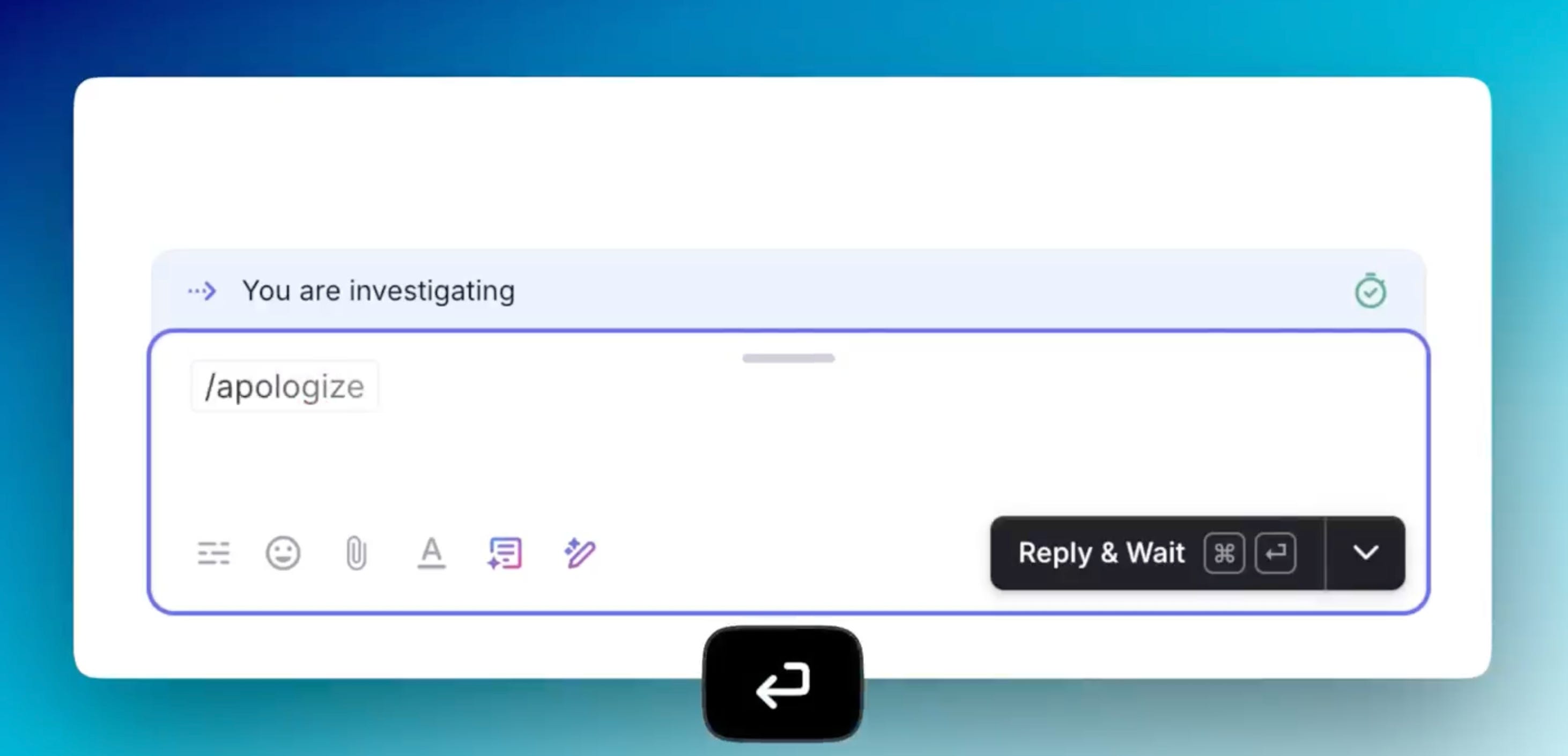
AI replies in plain - it’s just an amazing support tools for b2b that just understand what users actually need. Type the trigger and AI creates the content for you with all the context it needs.

The Real Challenge: Making AI Invisible
The real challenge for product teams isn't adding AI—that's relatively straightforward with today's tools and APIs. The challenge is making AI invisible.
This means:
Enhancing existing workflows rather than creating new ones
Focusing on outcomes rather than capabilities
Minimizing cognitive load by not requiring users to "think in AI terms"
Providing value immediately without training or setup
Maintaining consistency with the rest of your product experience
When AI feels like a separate feature or tool within your product, you've already failed. The goal should be so seamless an integration that users might not even realize AI is involved. They just notice that things work better, faster, or more effectively than before.
The Borrowed Expectations Problem
But there’s another major aspect that most product teams are missing: your users’ AI expectations are being shaped by products you’ve never considered competitors.
The AI tools your users interact with daily are setting their expectations for how ALL AI should work:
The way ChatGPT handles context switching and remembers previous interactions? That's now your benchmark for conversational AI.
How Midjourney interprets vague prompts and produces usable results despite ambiguity? Users expect your AI to be just as forgiving.
Gmail's smart replies that seem to read your mind? That's the new standard for suggestion quality.
I call these "borrowed expectations," and they're incredibly powerful. Your users aren't comparing your AI implementation to your competitors in your industry — they're comparing it to EVERY AI interaction they have across their digital lives.
Read more here:
The Consequences of Misalignment
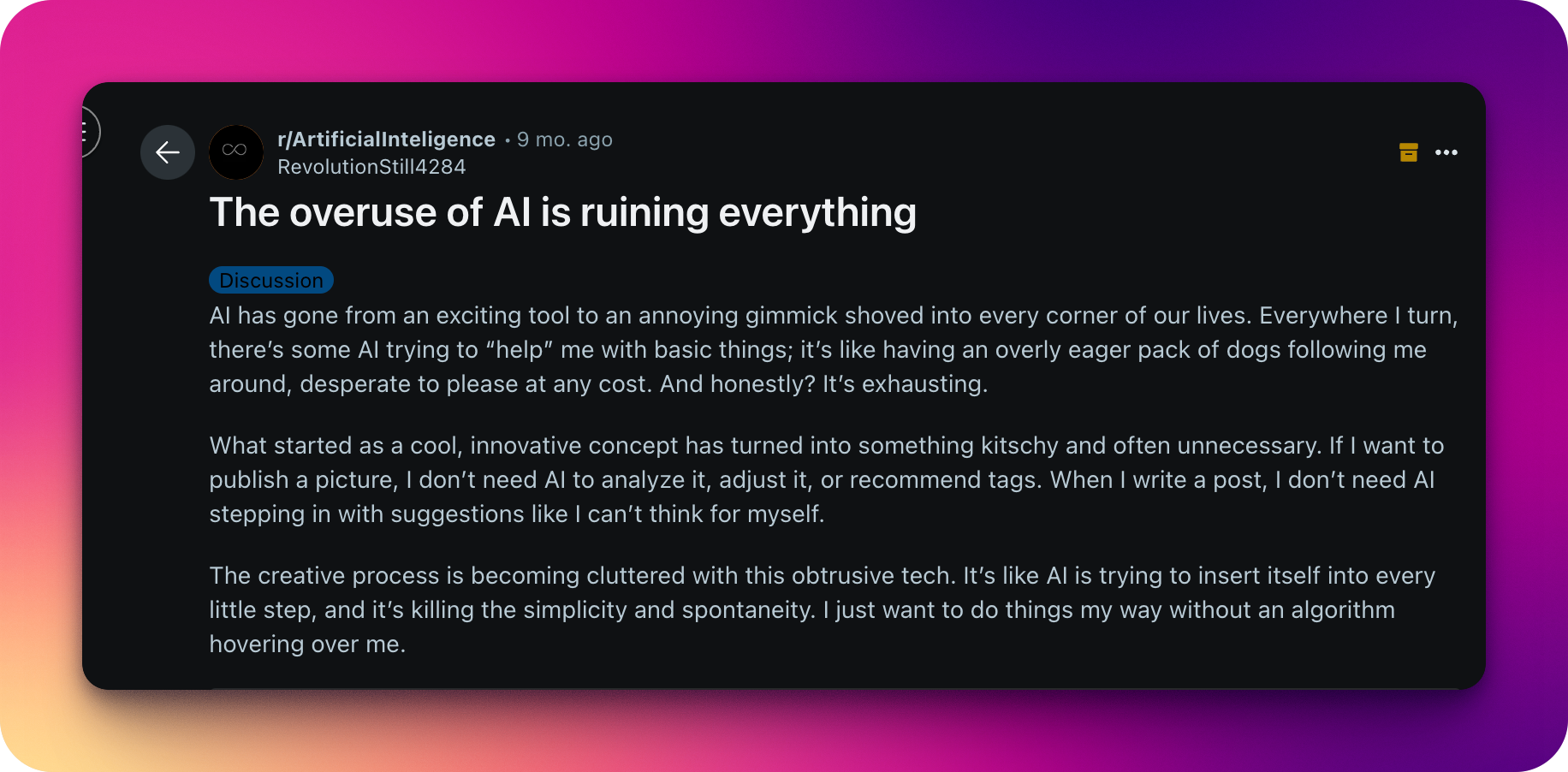
When your AI feature fails to meet these borrowed expectations, users don't think "this specific implementation is flawed"—they think "this product doesn't work for me" and drop off. Bye 👋🏼
I watched some companies recently launch AI features that technically worked perfectly according to their specifications. The models were accurate, the interfaces were clean, and the features delivered what was promised.
But users barely touched them because they didn't behave like the other AI tools they were using daily. The friction was too high, and adoption never reached its potential.
This misalignment creates several problems:
1. Low adoption rates for features that required significant investment
2. Negative perception of your product's innovation capabilities
3. Wasted development resources that could have been directed elsewhere
4. Confused users who don't understand why your AI doesn't work like others they use
Learning From the Successes
The most successful AI implementations I've seen didn't lead with "AI" at all. They just solved problems so seamlessly that users didn't even realize AI was involved.
Here’ are some examples:
Netflix's recommendation engine doesn't announce "AI-POWERED SUGGESTIONS!"—it simply shows you content you're likely to enjoy. (They used AI in some way for a long time on this)
Grammarly's writing suggestions appear naturally as you type, without requiring you to "activate the AI." (Although I stopped using it for other reasons 🙈)
Spotify's Discover Weekly delivers personalized playlists that feel curated just for you, without emphasizing the technology behind them.
These products succeed because they focus on the job to be done, not the technology doing the job.
Practical Guidelines for Product Teams
If you're working on integrating AI into your product, here are some guidelines to consider:
Start with the user problem, not the AI capability. Ask "What friction can we remove?" not "Where can we add AI?"
Map the existing workflow before designing the AI intervention. The more seamlessly it fits into current patterns, the better.
Minimize the "AI tax" - the additional steps or cognitive load required to use the AI feature.
Test against borrowed expectations by asking "How would users expect this to work based on other AI tools they use?"
Avoid AI-specific language in your interface unless absolutely necessary. Focus on outcomes, not technology.
Consider progressive disclosure - start with simple, reliable AI features and gradually introduce more complex capabilities as users build trust.
At my current work place, we're now heavily working on improving our AI offering, and it’s exactly those questions we ask our selves. Learning from past mistakes, and while be early in the AI game, we did not stick the landing perfectly.
Conclusion: The Future Belongs to Invisible AI
As AI capabilities continue to advance, the winners won't be those with the most sophisticated models or the most heavily marketed AI features. The winners will be those who integrate AI so naturally into their products that it becomes invisible — just another way the product delivers value. 💪🏼
Remember: Users don't care about your AI. They care about getting their job done with minimal friction.